
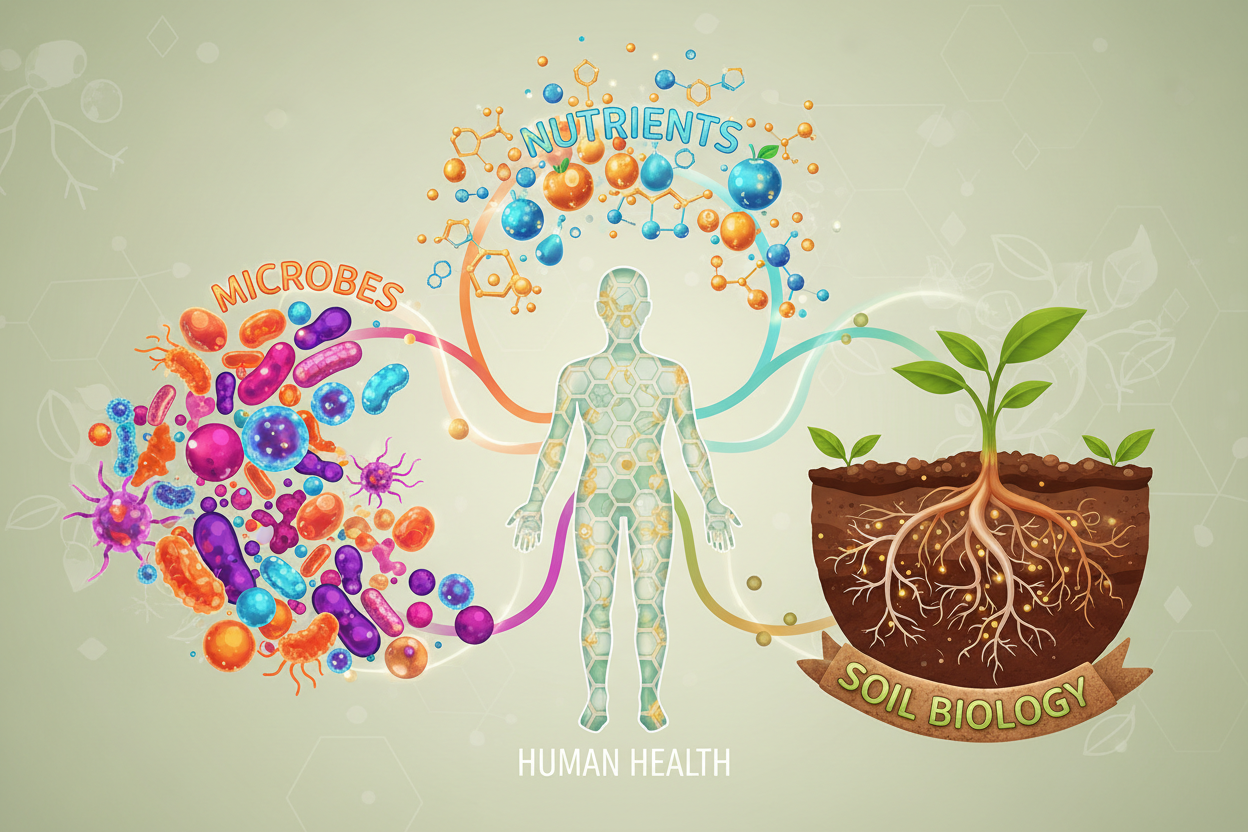
Cells are remarkably adaptive, but they are not self-sustaining. Their ability to coordinate, repair, and reorganize depends on conditions that extend beyond the tissue itself: signals must be clear; resources must arrive predictably; stressors & toxins must fall within adaptive limits.
None of these challenges to stability & resilience can be met by cells in isolation – and microbes play an essential role in influencing their communication and coherence.
soil → microbes → food → nutrients → cellular ecosystems
From this perspective, health is not produced solely inside the body. Health is co-created through an ongoing symbiotic exchange with the surrounding world.
Microbial communities as ecological partners.
Every major interface of the human body – the mouth, gut, skin, urogenital system, respiratory tract, eyes – is shaped by microbial communities. These communities are not passive residents; they actively participate in regulating local biology.
Microbes influence how epithelial tissues develop, how immune responses are calibrated, and how nutrients are processed before cells ever encounter them. Their metabolic byproducts become part of the chemical environment that cells interpret as signal rather than noise.
And this complexity is not binary – it’s dynamic, and contextual. So what matters most is not the presence or absence of any single organism or molecule, but the functional organization of the community as a whole.
When organization holds, the mucosal lining is stable enough to provide continuity and predictability in its (very important) barrier function, yet flexible enough to resist pathogens and adapt to change.
When it breaks down, tissues and cells are forced into a defensive posture, diverting energy away from repair and long-term maintenance.
Stable ecosystems do not eliminate variability and environmental insults. They absorb and reshape them for their own benefit.
Human health begins in the soil.
HEALTH is a reflection of a dynamic, collaborative, and awe-inspiring ecological complexity that involves microbes, nutrient supply & metabolism, and remediated exposure to environmental toxicity.
Long before nutrients reach human tissues, they pass through another living system: SOIL. So by the time nutrients enter the human mouth & gut, much of their biological meaning has already been shaped by climate events, agricultural practices, soil quality, and microbial composition.
Soil is not an inert substrate. It is a dense, living ecosystem composed of:
- microbes
- fungi
- minerals
- organic matter
- chemical gradients
Together, this complex ecosystem determines how nutrients are formed, transformed, and utilized by the human body.
If so, then it becomes very clear that (1) food supply is inseparable from the health of the soil in which it is grown and (2) healing a complex cellular ecosystem requires a lot more than a bolus of antibiotics.
What sustains and perturbs self-regulating ecosystems?
Ecological systems persist because they are redundant and adaptive – microbial diversity enables overlapping functions; cellular relationships can shift in response to disturbances without collapsing the whole.
Soil health, agricultural practices, and diversity of food sources & microbes all contribute to the health and resilience of human cellular ecosystems. But – over the last century – both agriculture and medicine have undergone profound transformation.
In agriculture, food production has become increasingly standardized. Large fields are dedicated to single crops; synthetic soil treatments & growth hormones are replacing natural soil replenishment methods; and toxic chemicals have become normalized to suppress weeds & pests, not only in industrial agriculture, but also in the average household.
Western medicine has followed a parallel trajectory toward a reduction in microbial diversity. While antibiotics and sterile techniques revolutionized healthcare and saved countless lives, everyday exposure to living microbes that support health and resilience has diminished. Traditional fermented foods, soil contact, and nutrient-rich food sources became less common features of daily life.
In both domains, the shift may have achieved consistency, scale, and control, but both cases have produced an unintended consequence – a marked reduction in microbial diversity across environments that once supported it.
When microbial diversity declines, so does ecosystem resilience.
Durable, self-sustaining biological systems rely on:
- functional redundancy across microbial metabolism
- flexible nutrient utilization
- buffered immune responses
- layered defense rather than singular control
When these elements align, health becomes robust. Not perfect, but resilient.
When microbial ecosystems lose diversity, their ability to buffer disturbances decreases: signals become noisier, responses become exaggerated, and minor stressors can provoke outsized reactions.
This loss of buffering capacity is contributing to the rising prevalence of auto-immune disease and chronic inflammation – manifesting as irritation, sores & ulcers, hypersensitivity, and spreading immune activation that affect the body’s barrier function at interfaces with the environment.
These patterns are not failures of immunity. They reflect ecosystems that have lost the relational depth and alignment required to regulate themselves smoothly.
How living systems repair themselves.
Living systems are built to handle variability. They don’t return to a fixed ideal state – they repair by reorganizing. After a disturbance, cells, tissues, and microbes adjust their relationships and optimize functions until a new coherence emerges.
The healing process heavily depends on feedback and cellular communication. Disturbances must be sensed, interpreted, and responded to in exact proportion to need. When feedback remains intact, repair unfolds gradually and quietly, even if the insult persists – as long as it is within a range the system can adapt to.
However, when cellular communication is disrupted (which can happen with persistent environmental stresses or as a result of resource instability or conflicting signals), tissues and micro-environments can slip into long-term defensive mode, indiscriminately spreading inflammatory signals and damaging healthy areas.
Repair emerges from relationship, not instruction.
No single molecule instructs a tissue to heal. No isolated cell restores function on its own. Repair emerges when relationships regain alignment and coherence across scales.
At the cellular level, this means coordinated signaling between epithelial cells, immune cells, and supporting tissues. At the microbial level, it means diverse communities that curb inflammation and support stem cells rather than amplify stress signals. At the organism level, it means environments that provide life-enabling, non-toxic resources and ongoing nourishment.
When these layers align, health and cellular repair becomes energetically efficient. When they do not, even well-intentioned interventions may struggle to produce durable change.
This is why regeneration often appears gradual rather than dramatic. It is not imposed. It is allowed.
Implications for regenerative health.
Understanding health as an ecological achievement reframes healing and repair in important ways. Regeneration is no longer defined solely by growth or replacement. It becomes the restoration of conditions that allow living systems to reorganize themselves.
This perspective shifts emphasis away from forcing outcomes and toward supporting coherence and alignment. It recognizes that resilient, lifelong health depends on:
- environments that stabilize rather than confuse biological signals
- inputs that vary within meaningful patterns
- Sufficient time to resolve feedback and adjust relationships
In this framing, regenerative health is not driven by interventions – it is a by-product of systems-level thinking and symbiosis with ancient microorganisms that continue to enable human life.
Clinical tools, nutritional strategies, microbial support, and clean agricultural practices all have roles to play – but their effectiveness depends on how well humans can let go of strict controls and trust nature to rebuild the larger ecological context of the body and its environment.
From ecology to healthcare.
Because ecological inputs are distributed – across agriculture, food systems, communities, and environments – health is not solely an individual accomplishment.
It is collective.
When health is understood as a reflection of ecological coherence, different questions become a priority. Instead of asking how to control inputs or suppress outcomes, we should ask:
What conditions allow biological systems to reorganize themselves toward stability?
Such questions do not diminish the value of modern medicine. They clarify its role.
Acute care can remove immediate threats; targeted therapies can interrupt harmful processes. But long-term health and resilience depend on what happens between interventions – in the daily conditions that shape how cellular ecosystems function.
Healing, at its core, is not a command issued to the body.
Self-repair & resilience is a capacity that emerges when living systems are supported in their dynamic, collaborative functions, with alignment across biological scales and time.