
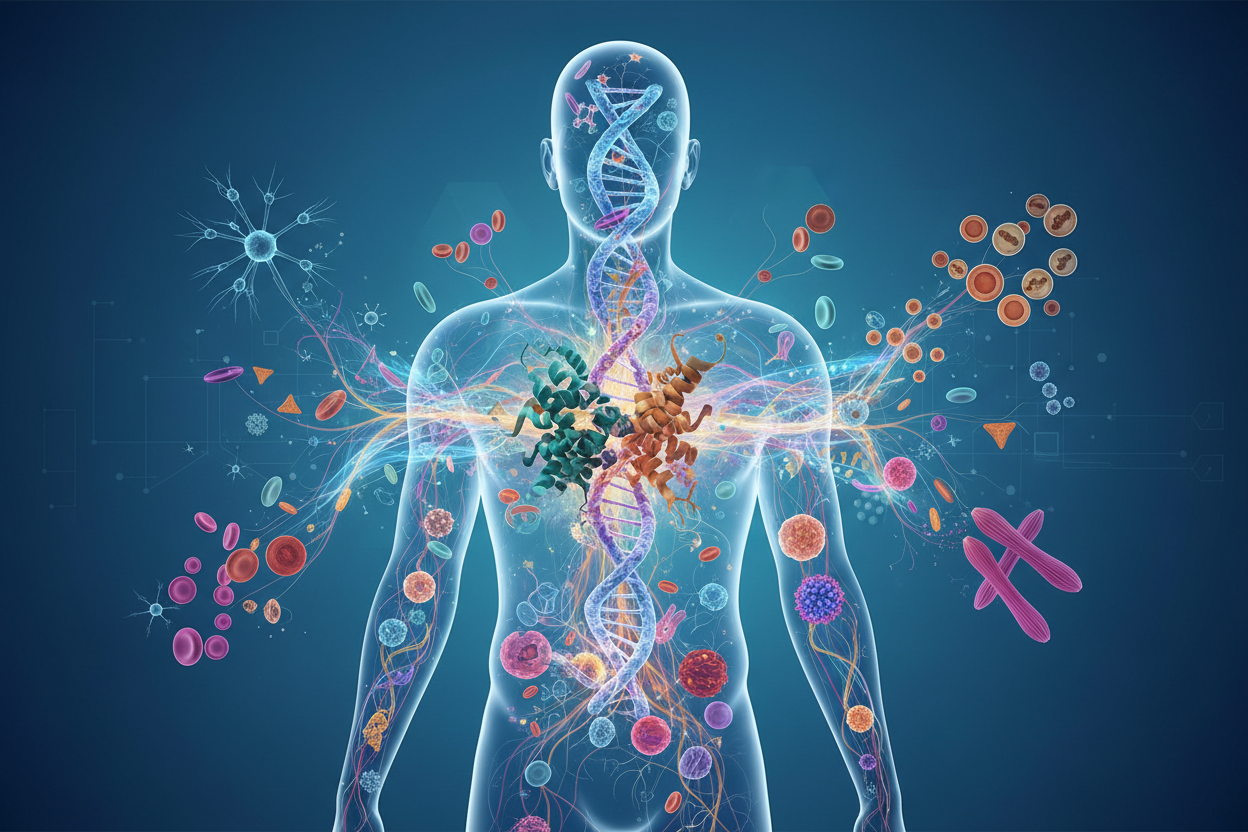
Cells do not act alone.
Modern biology has been shaped by extraordinary successes in molecular and cellular reductionism. By isolating genes, signaling pathways, and cell types, we have learned how biological components function in controlled settings. This approach has delivered immense explanatory power – but it has also shaped how health and disease are conceptualized.
To simplify complexity and build reliable scientific models, cells are typically defined as:
- discrete units with predefined roles
- responders to linear cause–effect signals
- components whose dysfunction can be localized and corrected
- Functioning parts of a fixed program
In reality, cells in live tissues behave more like participants in a community – and their actions are shaped continuously by what surrounds them.
So, a cell’s identity is not determined solely by its genes or internal machinery. It is shaped by where the cell is, who its neighbors are, what signals are present, and how conditions change over time. The same cell can behave very differently depending on context.
Health, therefore, is not just a sum of well-functioning parts or contribution of individual cells. And disease isn’t just an issue of inflammation that can be fixed with acetaminophen or corticosteroids.
The human body is a dynamic, resilient cellular ecosystem – and modern medicine could benefit from innovation aligned with this perspective.
Living tissues as tiny cellular ecosystems.
Living tissues function as ecosystems at a microscopic scale. Within them, many different cell types coexist, communicate, and adapt to shared local conditions. No single cell directs the system. Coordination emerges through interaction.
In healthy tissues, this coordination takes many forms. Cells exchange signals continuously with their neighbors. Roles shift in response to need rather than remaining fixed. Microbial residents contribute metabolites and byproducts that shape local chemistry. Spatial organization allows tissues to withstand mechanical forces. Redundancy provides flexibility, and feedback mechanisms prevent runaway responses.
Together, these factors create resilience.
When the balance of inputs remains coherent, tissues adapt and rebuild. This adaptive capacity is often experienced clinically as health. When coherence is not restored—when signals conflict, resources fluctuate unpredictably, or feedback breaks down—tissues can lose their ability to reorganize. Over time, this loss of relational coherence may appear as chronic dysfunction rather than acute disease.
These properties are not accidental. They reflect deep evolutionary principles that have shaped life since its earliest beginnings. From primordial microbial communities to complex multicellular organisms, stability has always emerged from interaction rather than control. The same forces that transformed early cellular life into diverse global ecosystems continue to operate within human tissues today.
Repair versus rebuilding.
This perspective also reframes how interventions are understood.
A prescribed course of antibiotics, for example, may be necessary in the presence of severe infection – and in such cases, suppressing or eliminating a dominant threat can be lifesaving. But even then, an important question remains: what helps the system rebuild after disruption?
Eradicating a pathogen does not automatically restore an ecosystem. Recovery requires time, resources, and environmental conditions that allow cellular and microbial relationships to reestablish coherence. Without this rebuilding phase, tissues may remain fragile even after the immediate problem has been addressed.
This distinction – between removing a stressor and restoring functional relationships – becomes increasingly important when health challenges are chronic, diffuse, or slow to resolve.
Healthcare implications: from fixing parts to restoring relationships.
The the history of living cellular ecosystems – and their central role in rebuilding and maintaining human health – reminds us that the answer to health & longevity is not rigid control or perfectly functioning components.
Health is sustained through cellular relationships that allow living systems to respond, reorganize, defend, and endure. When these dynamic relationships remain organized and coherent, tissues adapt with remarkable resilience. When communication and balance is disrupted or lost, dysfunction and disease emerge – not suddenly, but gradually, as specific parts of the ecosystem start to dominate or go awry.
Understanding health in this way does not simplify biology. If anything, it makes it much more complicated and difficult to study.
However, this perspective also helps create context around how we currently treat disease and, hopefully, illuminate a path forward that strives to integrate ancient mechanisms of ecosystem survival and resilience into modern scientific discovery.
And it invites a broader question: what supports – or undermines – these cellular ecosystems over time?